Germicidal UV · Architectural light · Onboard proof

The light that cleans the air,
and more.
LISAWaves™ is an architectural luminaire with continuous UV‑C air treatment and soft bipolar ionization built in — and a full sensor suite that doesn't just promise clean air, it measures it.
Chart: airborne MS2 reduction, independent GLP-protocol test, one fixture in an 800 ft³ chamber (ARE Labs). Dose ratios per Wilson et al. 1992 and Heßling et al. 2020. Animation is illustrative.
One fixture, MULTI-FUNCTION
Illuminate. Save.
Purify. Control.
Traditional light fixtures are always 100% on. LISAWaves™ delivers up to 85+% energy savings with daylight harvesting.
Air treatment usually means another mounted fixture, another filter contract, another thing to manage. LISAWaves™ puts everything where the coverage already exists — the lighting layer — and monitors and controls every aspect of it.
Architectural light, mesh-controlled
A high-quality LED luminaire first — dimming, scenes, schedules, presence and daylight response.
Circadian scheduling puts the right light at the right hour — the one building-side lever against teen sleep loss, night wandering in elder care, and night-shift error rates.
All native on Casambi Bluetooth mesh. No extra control wiring, no gateway box per room.
Continuous UV-C
+ ionization
Sealed UV‑C germicidal chambers treat air as it circulates — the same class of technology hospitals rely on — while soft bipolar ionization helps agglomerate fine particles out of the breathing zone.
Designed for occupied spaces: the UV-C stays sealed inside the chamber, and the soft bipolar ionization produces no measurable ozone.
And it runs its lamps smarter: twice the usable UV‑C lamp life of the industry standard.
LWControls™. Onboard
sensing. One dashboard.
- Daylight harvesting
- Occupancy — IR motion
- Circadian rhythm
- Audible output
- Sound recognition
- Video capable
Facilities get a one-source dashboard. Occupants get air that's being watched, not assumed.
Everything LISAWaves™ measures in your air — available live, from every fixture, in real-time.
What it neutralizes
It's not just the UV‑C.
It's the dose.
Think of UV-C like medicine: each germ needs a specific dose before it's inactivated. Too little and nothing happens — you're just wasting energy. Scientists have measured that exact "kill dose" for viruses, bacteria, and mold, and it comes down to two things: how much UV-C actually reaches the germ, and how long the germ is exposed to it. And how much reaches the germ is about far more than how much UV-C the fixture makes — our mirror-lined chamber bounces it back again and again, so a germ passing through is hit much harder than it would be in a fixture without reflectors, even one producing the same amount of UV-C. Everything in the LISAWaves™ UV engine is built to raise both.
To find out how we compare to competitors and why LED UV-C is a marketing gimmick, click here
- ▸Make a lot of it. Our two UV-C lamps run at 72W total and put out a combined 27 watts of germicidal UV-C — more cleaning power than the single 95-watt lamp used by most competitors, while using over 25% less electricity to do it.
- ▸Waste none of it. The air chamber is lined with 90%+ reflective, UV-C-stabilized aluminum, so UV-C that misses on the first pass bounces around and keeps working.
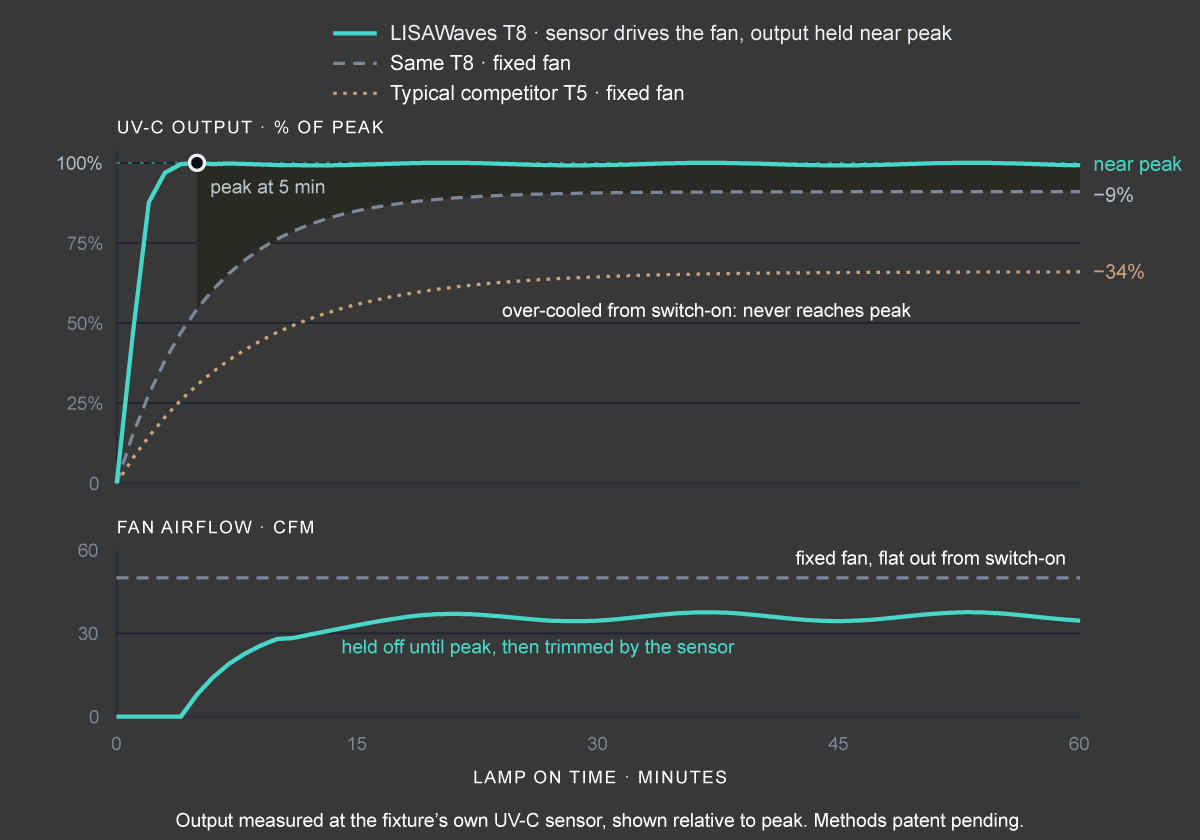
- ▸Keep it steady, room after room, year after year. Our lamps hit their peak at normal room temperature (~25 °C) — the common 95-watt lamp needs to run hot (~35 °C), so with a fan continually moving room-temperature air past it, it loses ~10% of its output.
- ▸Lowest UV-C depreciation. All UV-C sources lose UV-C output over their life. Our lamps only lose 15% at end-of-life, whereas the 95-watt lamps lose 20% and LEDs lose 30%. That means we produce more UV-C over the life of the lamp.
GERM-KILLING POWER (UV-C OUTPUT)
The takeaway: we exceed a 95W lamp's cleaning power using less electricity — and put out roughly 65× more UV-C than a real LED air-purifier module. Even the best UV-C LEDs turn only a tiny fraction of their power into UV-C, which is why LED gadgets deliver so little. Figures from the Philips TUV 30W & TUV PL-L 95W lamp datasheets and the Seoul Viosys 275nm LED spec.
| LISA Waves | Viable competitors | UV-C LED purifier | |
|---|---|---|---|
| Rated life | 18,000 h | 9,000 h | ~10,000 h* |
| UV-C output depreciation | 15% | 20% | 30%* |
| UV-C power at room temperature | 100% | 90%† | 100% |
| 4-year lifecycle cost | $29.90 | $100 | $500‡ |
| Procedure | Change lamps in minutes | Change lamps in minutes | replace the whole module — if serviceable |
| Effective? | Yes | Yes, using more power | No — snake oil |
*UV-C LED lifetime and depreciation is based on its L70 rating.
†UV-C lamps share the mercury-vapor physics of ordinary fluorescent lamps: The 95W lamp (T5) peaks near 35 °C and drops ~10% at 25 °C room temperature, Our lamps (T8) peaks at ~25 °C (Chung, HK PolyU, §2.3).
‡The leading UV-C LEDs— Seoul Viosys 3535, 275 nm — output 35 mW of UV-C at their maximum output. These LEDs run ~$11 in volume (500 pcs), matching our 27W would take ~770 LEDs. Typically not field-replaceable.
But aren't LEDs the future?
Even giving UV-C LEDs every benefit of the doubt, the math doesn't work — yet.
LED fans make fair points: their wavelength is a little more effective at killing germs, they aim their UV-C where you want it, and there's no warm-up or mercury. Let's grant every one of those. To still match the cleaning power of LISAWaves™, an LED fixture would need roughly this much — using the best UV-C LEDs money can buy today:
LEDs may get there as the technology improves in both efficacy and cost. Today they don't — which is why today's LED "air purifiers" can only use a small handful of LEDs and are ineffective in cleaning the air. Our two $14.95 lamps do the heavy lifting for a fraction of the power and cost.
The UV-C engine
We didn't just add UV‑C.
We advanced it.
Most fixtures treat the germicidal lamp as a consumable: switch it on, let it drift, replace it on a guess. LISAWaves™ closes the loop around its own UV engine — measuring real germicidal output and continuously managing how the lamps run. The methods are ours (patent pending); the results are measurable on every fixture.
Twice the lamp life
Advanced lamp management doubles usable UV‑C lamp life — 18,000 hours against the 9,000-hour industry standard. Half the relamps and half the maintenance visits, on every fixture, for the life of the installation.
Held at peak output
Germicidal output isn't constant — it moves with a lamp's operating conditions, so a fixture can look lit while quietly under-delivering. LISAWaves™ measures its own UV‑C output in real time and continuously self-optimizes to hold every lamp at peak.
Silent failures
By comparing how much power a lamp draws against how much UV-C it actually puts out, the fixture can tell a healthy lamp from one that's failing — and alert you the moment something's wrong, instead of at the next walk-through.
The energy ledger
Clean air, on the lighting budget.
- ▸Honest watts. Cleaning air takes power — the UV‑C lamps and ionizer can draw up to 75 W. We publish that number and meter it live on every fixture, because an energy story has to survive contact with a power meter.
- ▸The retrofit funds it. The fluorescent fixture it replaces was burning 62–112 W. LISAWaves™ lights the same space with 23–33 W of LED — on a typical 3‑lamp T8 swap, 88 W becomes 28 W, freeing 60 W before purification even starts.
- ▸Watts only when the room needs them. Competitors run their air cleaning wide open, all day, every day. LISAWaves™ modulates continuously on what it observes — occupancy, live air-quality readings, even acoustic events like coughing — so full power is spent only when the air actually calls for it.
THE LIGHTING SWAP — T8 FLUORESCENT → LISAWAVES LED
PLUS — DEMAND-BASED AIR CLEANING
HATCHED = DEMAND-BASED · RARELY AT FULL POWER
LIGHT THE ROOM AND CLEAN THE AIR —
ON ROUGHLY THE POWER BUDGET YOU ALREADY HAD
Proof, not promises
It doesn't just claim.
It reports.
- ▸The UV watches itself. A dedicated UV‑C intensity sensor tracks lamp output over life. When output fades toward the replacement threshold, you get a service alert — not a silent fixture that stopped treating months ago.
- ▸Runtime accounting per consumable. Lamp hours and ionizer runtime are metered on-device and survive power cycles, so replacement schedules run on truth instead of guesswork.
- ▸Electrical health included. Built-in power metering (watts, volts, power factor) feeds driver end-of-life prediction — a failing driver is flagged weeks before it takes the light down.
- ▸Smart alerts, not noise. Telemetry lands in LISAWaves™ Controls, where patent-pending alerting surfaces the three things that need action and mutes the routine.
Fits the ecosystem you already run
Casambi-native. Cloud-connected.
- ▸Native Casambi mesh. Commission it like any Casambi luminaire — it joins the network, takes scenes and schedules, and responds to presence and daylight like the rest of the lighting.
- ▸Full remote control. Light level, UV mode, ionizer, and fan are all controllable from the Casambi app and from LISAWaves™ Controls — per fixture, per group, or per site.
- ▸Fleet-grade operations. Over-the-air firmware for the whole installed base, staged safely with automatic rollback — a fixture never bricks on an update.
- ▸Part of LISAWaves™ Controls. Every LISAWaves™ shows up in the same console as the rest of your controls — same maps, same alerts, same access model.
Activated by license, not by truck roll
The hardware ships ready.
Turn features on when you need them.
Every fixture carries dual microphones and edge AI compute. Capabilities below switch on by software license — per fixture or per site. Features built on air-quality or camera sensing require the matching hardware option.
Gunshot & emergency detection
On-device acoustic classification tells firearm discharge from other loud events. Neighboring fixtures corroborate and triangulate before an alert dispatches, and the RGBW bar switches to directed exit guidance.
Audio transcription
Room audio as a service to the people in it — a written record of a clinic visit, or spoken language a school needs flagged for staff review. Access-controlled and site-enabled.
Vape & smoking detection
Particulate and TVOC signatures identify vaping and smoking in restrooms and locker rooms — zone-level alerts in real time, no cameras required.
Air quality auditing
Continuous per-zone records across every measured channel, with compliance-style reporting — documented proof of air quality for schools, clinics, and public buildings.
Data storage & analytics
Long-term retention of every telemetry channel with trends, baselines, and anomaly detection — plus export and API access for building systems.
Acoustic health analytics
Cough and sneeze detection trends respiratory events by zone — an anonymous, aggregate signal that can drive demand-based air cleaning on its own.
Energy metering & reporting
Per-fixture true-power metering rolls up to site-level energy reporting and feeds predictive maintenance, including driver end-of-life alerts.
Occupancy & space utilization
Presence and ambient sensing aggregate into utilization trends by room and zone — data for right-sizing space, cleaning schedules, and HVAC coordination.
Camera event detection
The optional onboard camera corroborates acoustic events with visual snapshots, giving responders eyes on the space the moment an alert fires.
Documentation
Every number, on the record.
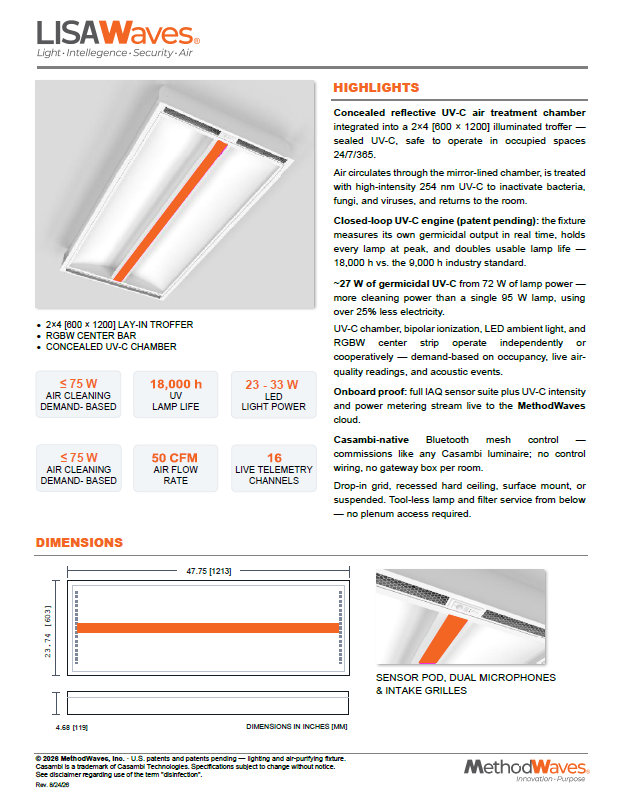
Full specifications — housing, optics, UV-C engine, sensing, controls, mounting, certifications, catalog numbers and replacement parts.
Specify it, pilot it, measure it
Put clean air
where the light already is
and watch it work.
We'll bring a fixture, light up a live dashboard, and let your own space generate the data.